CarsPublished:
BMW logs one million driverless vehicle movements inside its plants
Automated Driving In-Plant is confined to defined production and logistics areas, where sensors mounted in factory infrastructure guide new vehicles regardless of their equipment specification.
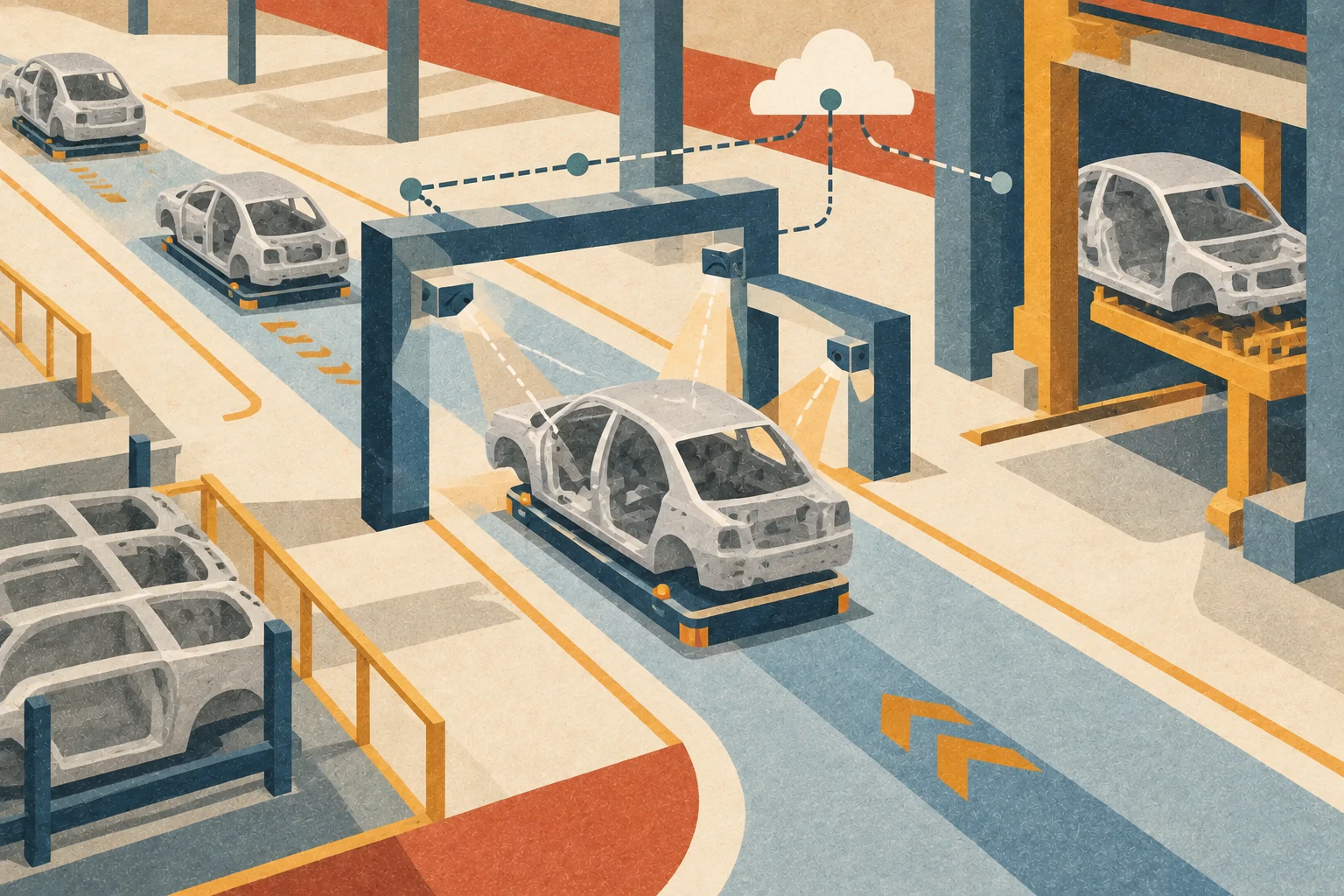
BMW Group says its plants have completed one million automated vehicle movements using Automated Driving In-Plant, or AFW. The system began with a pilot at BMW Group Plant Dingolfing in 2022 and has since been deployed at four sites, with Plant Spartanburg next in line.
AFW moves new vehicles without drivers inside defined production and logistics areas. BMW says the system can respond dynamically to people, other vehicles, driverless transport vehicles, logistics traffic, and temporary obstacles.
MINI Plant Oxford recorded more than 53,000 automated vehicle movements in the past year. BMW says the wider rollout improves production flow and makes factory logistics more efficient.
The factory carries the sensors
AFW relies on offboard sensors installed in plant infrastructure instead of requiring each vehicle to carry the automated-driving sensor package. That lets the system move vehicles with different equipment specifications while monitoring larger areas and narrow passages.
BMW says AFW is CE-certified for use in the production environment. The certification and infrastructure-based design support expansion into additional plant areas and locations, according to the company.
Oxford connects vehicles directly to factory controls
BMW says Oxford became its first site to link automated guided vehicles directly to existing factory controls. AFW places a vehicle beside a lifting device for a specific operation, and a cloud-based solution coordinates the interaction between the vehicle and the equipment.
The one-million-movement figure describes factory and logistics operations, not public-road driving. Its significance is the move from a single 2022 pilot to a repeatable production process across multiple plants.
Next story
Related stories
BMW will send three M4 GT3 EVOs to the 2026 Macau finale

Teams WRT and KRC will field Kelvin van der Linde, Raffaele Marciello and Augusto Farfus at the FIA GT World Cup on November 21 and 22.
BMW's autumn 2026 update adds new 7 Series and X5 choices

BMW lists December 2026 as the production start for three new X5 variants; the release describes German-market specifications without setting delivery dates elsewhere.