Security & FraudPublished by Svertok:
The first hour of a cyber incident is for containment and evidence, not certainty
The first hour is for limiting damage, preserving useful evidence and assigning owners—not declaring a cause too soon.
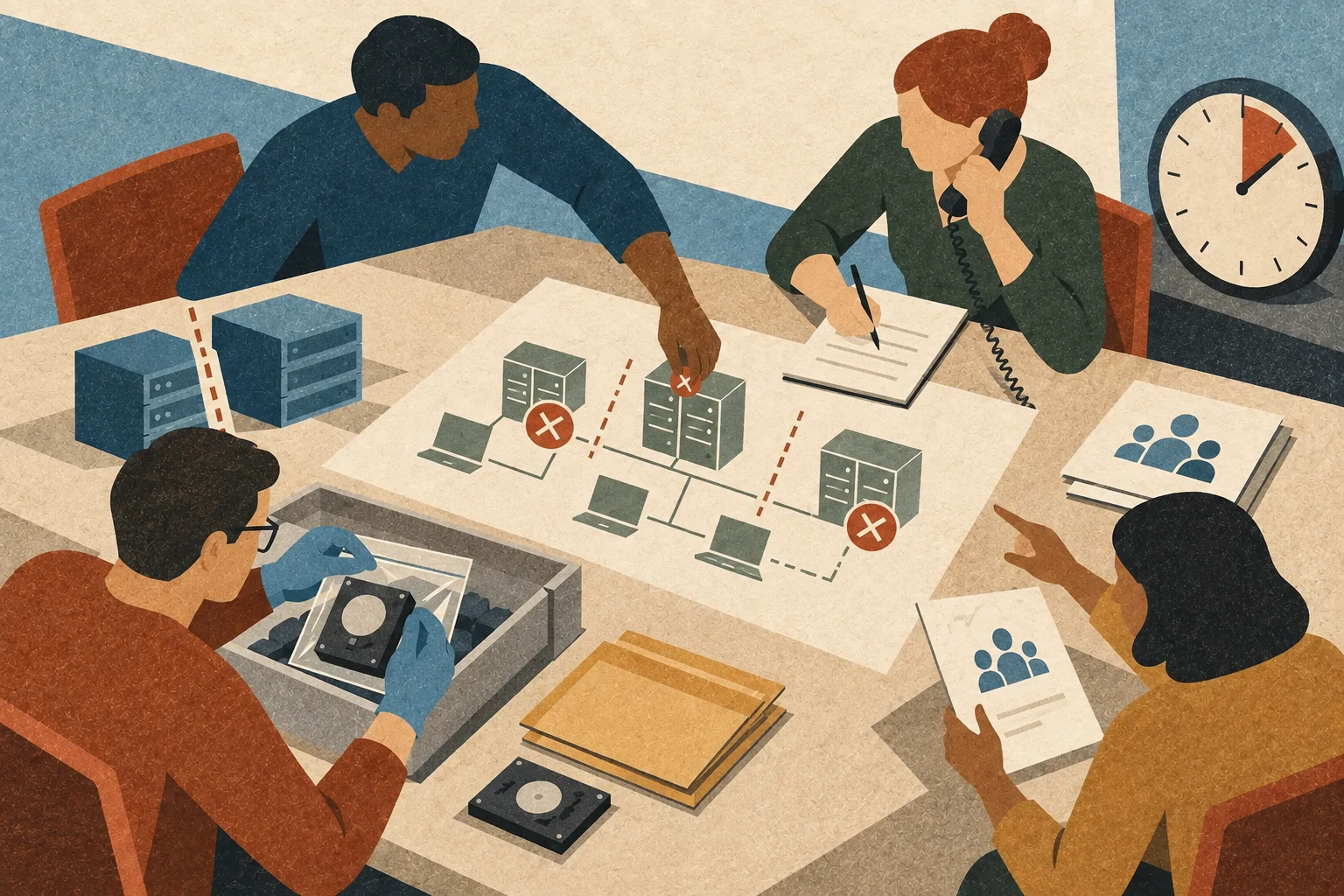
An incident rarely arrives with a complete map. Treat the first alert as a lead: record the account, host or service it identifies, then keep the entry point and full scope open until evidence supports them. Take the smallest safe action that limits further harm without erasing the evidence needed to understand it.
Stabilize without erasing the trail
- Isolate only the hosts, accounts or services needed to contain immediate harm.
- Record times, observed behavior, alerts and every action already taken.
- Protect logs and volatile information before they roll over or disappear.
- Name one coordinator and clear owners for containment, evidence, operations and communication.
An aggressive shutdown can destroy evidence or create another outage when the scope is still unclear. A shared timeline is more useful than several private theories.
Say only what the evidence supports
Early indicators can show that something is wrong without identifying the attacker, entry point or full impact. Separate observations from hypotheses and update both as evidence changes. The hour succeeds when harm is being contained, the record remains useful and the team knows what it must learn next.
A decision log prevents the response from becoming another mystery
Record who made each containment decision, when it happened, which evidence supported it and what the action was expected to protect. That log does not need polished prose during the first hour. It needs accurate times, owners and observations. Later, it helps the team distinguish an attacker’s activity from its own emergency changes, explain an outage and reverse a containment step safely. A short disciplined record can preserve context that memory loses as more responders join.
Next

Microsoft Centers Its Ignite 2026 Security Program on AI Agents
The November program will examine the identities, data and cloud resources that AI agents can access while previewing Microsoft's security roadmap.
Read next
CISA flags a Citrix NetScaler memory-buffer flaw as actively exploited
CVE-2026-88779 has entered the Known Exploited Vulnerabilities catalog, raising its remediation priority while leaving the attackers and campaign scale unidentified.
Read
GitLab urges immediate updates for critical self-hosted AI Gateway flaw
A crafted flow configuration could let an authenticated Duo Agent Platform user escape a prompt-template sandbox and execute commands on the gateway. GitLab rates the issue CVSS 9.9.
Read