ScienceNews date: Published by Svertok:
Webb reveals hidden young stars and gas-shaping outflows in NGC 7129
The infrared observatory's new view shows how light and jets from developing stars clear, energize and compress material inside a stellar nursery about 3,300 light-years away.
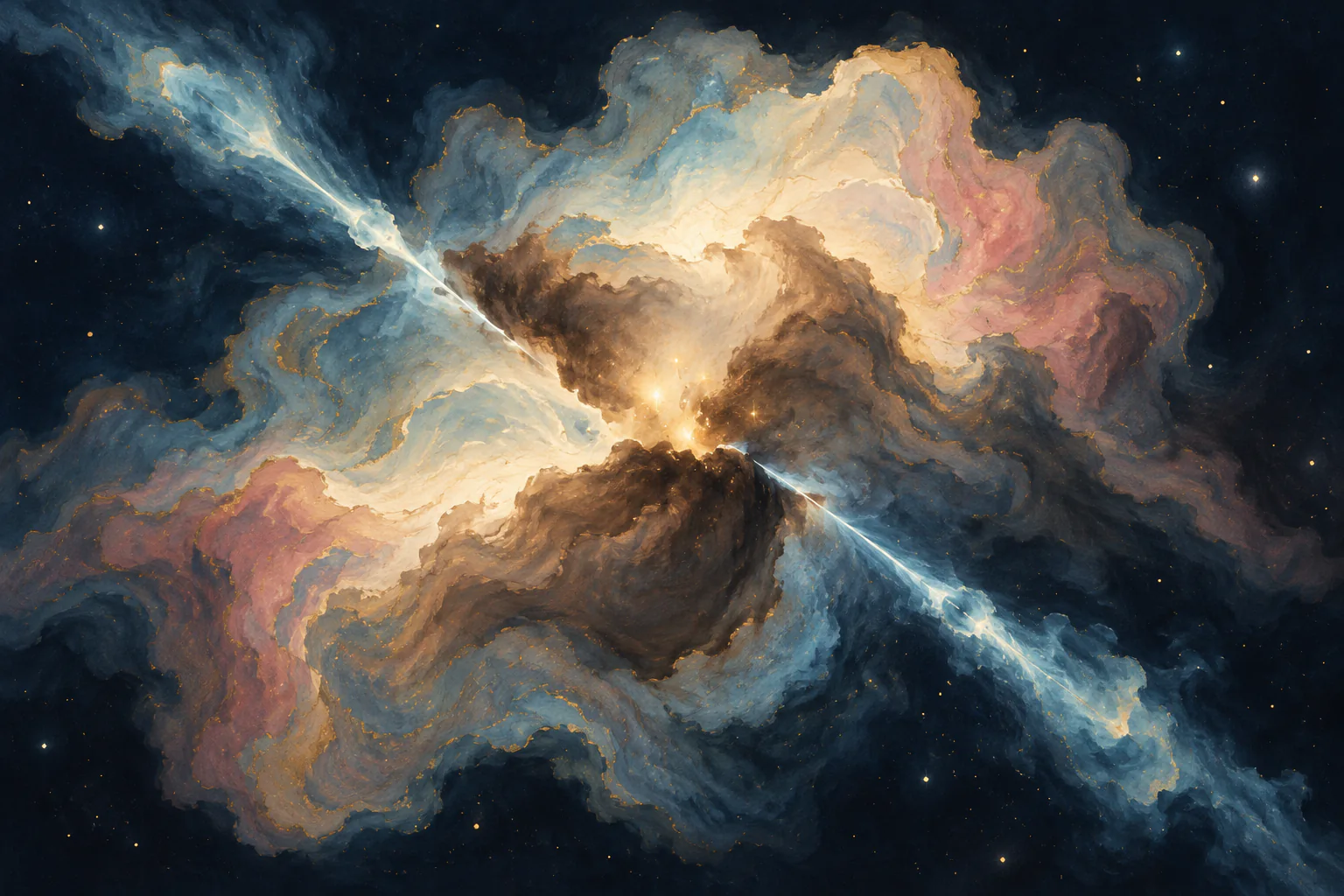
NASA reported on October 6, 2026, that the James Webb Space Telescope has revealed numerous stars previously hidden by dust in NGC 7129, a stellar nursery about 3,300 light-years from Earth. Webb's infrared sensitivity lets astronomers look through dusty molecular clouds and examine an early stage of the stellar life cycle.
Young stars reshape their birthplace
A gold-colored cavity in the image spans about 3.5 light-years and shows the influence of a central star. Outflows from an earlier stage of that star's development carved into a dense cloud of hydrogen, while the outflows and starlight energized the gas and made it glow.
The same activity has two effects: much of the hydrogen is blown away, while another large portion is compressed. NASA says that compression creates conditions in which more stars can form, linking the destruction and renewal visible within the cloud.
Elsewhere in the image, Webb resolves additional protostellar outflows and a young star surrounded by a donut-shaped disk. The disk casts a shadow across a blue nebula, resembling the structure called the Bat Shadow previously observed by the Hubble Space Telescope.
Webb also resolves finer gas and dust filaments than NASA's retired Spitzer Space Telescope and reveals many background galaxies. Astronomers plan to keep using the data to study how stars and protostars affect the surrounding gas and dust.
Next
Niobium in old Hubble data points to a possible planet born after its star died
Researchers interpret an unusual chemical signature around white dwarf HS 0209+0832 as a sign of a Jupiter-size second-generation planet, but the world remains a candidate.
Read next
NASA targets Oct. 13 for SpaceX's 35th station resupply launch
Dragon is set to carry more than 6,300 pounds to the International Space Station, including the final set of roll-out solar arrays.
Read
DOE Announces Conditional $4.2 Billion Commitment for Nuclear Upgrades
The financing could support Vistra uprates and modernization in Pennsylvania and Ohio, but the commitment is conditional and its stated grid and cost benefits are projections.
Read