CarsNews date: Published by Svertok:
Porsche puts the Cayenne Electric's towing, terrain and charging claims on display
A Cappadocia media drive paired a market-dependent 3.5-tonne towing limit with off-road hardware, a 113-kWh battery and charging at up to 400 kW under optimal conditions.
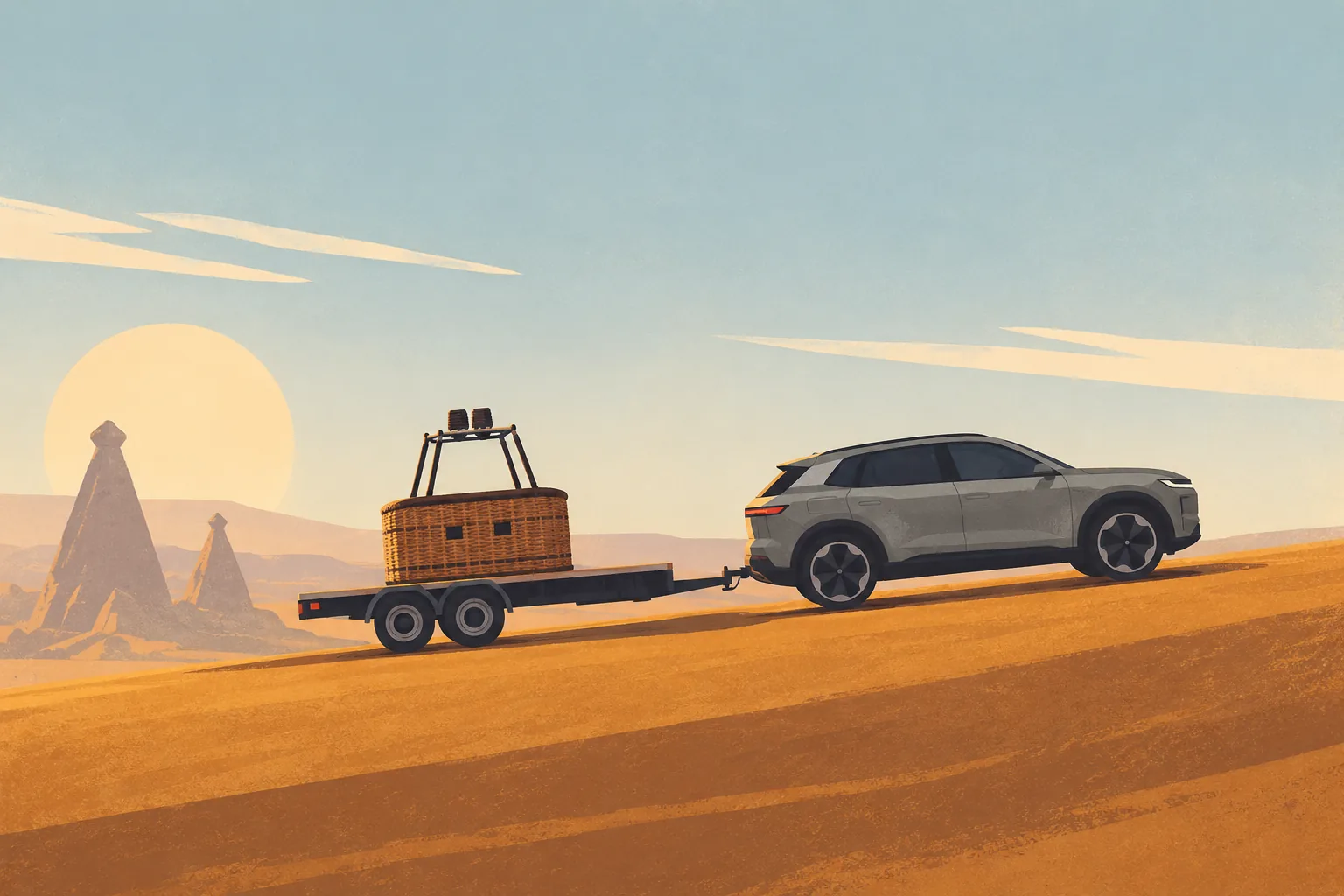
Porsche used a media drive in Cappadocia, Turkey, to show the Cayenne Electric on paved roads, gravel tracks and rocky terrain. The event included the Cayenne Electric, Cayenne S Electric and Cayenne Turbo Electric, with the most practical headline being a towing capacity of up to 3.5 tonnes depending on the market and vehicle specification.
That towing figure was illustrated by a Cayenne Electric hauling a trailer as a hot-air-balloon basket landed on it. The demonstration establishes the vehicle's stated maximum under qualifying specifications, rather than a universal rating for every version and market.
Hardware for rougher ground
The route moved from asphalt to loose surfaces and short, demanding off-road sections where ground clearance, traction and controlled delivery of electric-motor torque mattered together. Porsche says its Active Ride suspension is available on the Cayenne S Electric and Cayenne Turbo Electric. The system stabilizes the body over uneven ground while allowing greater axle articulation because it does not use mechanical anti-roll bars.
Traction equipment differs by model. The Cayenne Turbo Electric has an electronically controlled limited-slip differential as standard, while Porsche Torque Vectoring Plus is optional on the Cayenne S Electric.
Battery and charging limits
The electric Cayenne uses a 113-kWh high-voltage battery cooled from above and below. The S and Turbo versions add an oil-cooled rear electric motor to support sustained performance.
Porsche states that the Cayenne Electric can recover braking and downhill energy at up to 600 kW. Its 800-volt electrical architecture supports DC charging at up to 400 kW under optimal conditions, so drivers should read that number as a peak rather than an assured rate at every charger or in every situation.
Next
Leapmotor B03X electric SUV starts at A$29,990 drive-away under a limited Australian offer
The compact SUV is due in Australian dealerships in November with two battery sizes, WLTP-rated range claims of up to 292 or 382 kilometers and important limits on its advertised pricing.
Read next
BMW’s Millionth M Car Points to an Electric M3 Built in Munich
The milestone M3 marks more than five decades of BMW M production as the company prepares its main Munich plant for an electric-only future.
Read
BMW Separates the X3 M50 Power Boost From Its New Black Package
The optional styling package arrives from December, but every X3 M50 xDrive gets the stronger 443-hp engine and quicker acceleration figures.
Read